
Our offensive security department has completed comprehensive penetration testing and vulnerability assessments across numerous European enterprises over the past year. The findings reveal critical patterns in organizational security posture that demand immediate attention.
Key Statistics:
- Average 7-8 vulnerabilities per engagement (ranging from 3-15 depending on scope and infrastructure complexity)
- 25% Critical or High severity vulnerabilities requiring immediate remediation
Vulnerability Severity Analysis
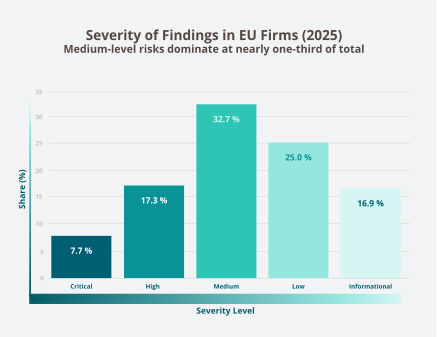
The data shows a concerning 7.7% of critical findings that pose immediate business risk. However, what’s particularly troubling is that 1 in 4 findings reaches critical or high severity - indicating systemic weaknesses in security fundamentals.
Breakdown by Severity:
- Critical (7.7%): Requires immediate action - these bypass core security controls
- High (17.3%): Significant risk requiring 30-60 day remediation windows
- Medium (32.7%): Important but can be strategically prioritized
- Low (25.0%): Address within standard patch cycles
- Informational (16.9%): Monitor for security intelligence value
Key Insights & Patterns
The Patch Management Crisis:
Outdated software dominates our findings—it’s not a technical limitation but an operational challenge. Organizations need:
- Automated patch assessment tools
- Clear SLAs for critical patches (24-48 hours)
The Configuration Problem:
Many vulnerabilities stem from features that are deployed but misconfigured. HSTS headers exist but lack proper directives. Firewalls block ports but allow management interfaces. This suggests:
- Security configurations treated as afterthoughts
- Insufficient security in deployment pipelines
- Lack of baseline security hardening standards
Data Leakage as the Quiet Threat:
Information disclosure vulnerabilities don’t trigger alerts but enable reconnaissance Companies reveal:
- Software versions (enabling targeted exploits)
- Architecture details (aiding attack planning)
- Credentials in git histories (persistent access)
Injection Attacks - The Persistent Problem:
Despite decades of warnings, injection vulnerabilities remain pervasive. Root causes include:
- Insufficient input validation at application layer
- Developers unaware of secure coding practices
- Lack of static code analysis in CI/CD pipelines
- Legacy code with accumulated technical debt
Cryptography - Still Getting It Wrong:
TLS/SSL issues persist despite 20 years of best practices. Organizations continue to:
- Support deprecated protocols for “legacy compatibility”
- Use weak ciphers “for performance”
- Deploy self-signed certificates “for testing” (that never get updated)
Top Vulnerability Categories: Where Companies Struggle the Most
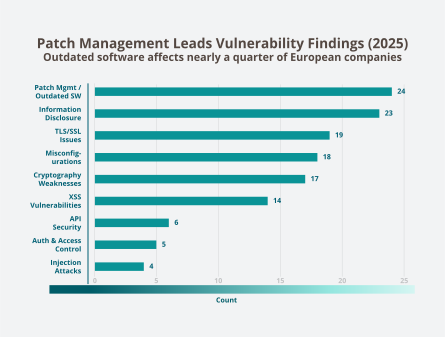
Most Common Vulnerability Categories in European Companies
The most alarming trend isn’t a single vulnerability— it’s systemic categories appearing repeatedly across assessments:
1. Patch Management & Outdated Software
The #1 culprit across European enterprises. Organizations struggle with:
- Unsupported OS versions (Ubuntu 16.04, Windows endpoints)
- Outdated libraries (jQuery, Apache, PHP)
- Delayed vendor patches (Cisco IOS, FortiOS, Moodle)
2. Information Disclosure
Companies inadvertently leak sensitive data through:
- Exposed configuration files and documentation
- Leaked credentials in code repositories (GitHub, Docker files)
- Verbose error messages revealing system architecture
- Unprotected database ports and admin interfaces
3. Misconfigurations
Security features deployed but improperly configured:
- HSTS headers missing or misconfigured
- BitLocker without pre-boot authentication
- SMB signing disabled
- Unrestricted DNS transfers (AXFR)
- Open AWS S3 buckets and similar cloud misconfigurations
4. Injection Vulnerabilities & Malicious User Input
Both direct injection attacks and input validation failures appearing repeatedly:
- SQL Injection: Bypassing authentication on login screens
- XSS (Stored & Reflected): File operations, user input fields, search parameters, redirect functions
- DOM-based XSS: JavaScript processing without proper sanitization
- Code Injection: Arbitrary code execution through deserialization
- Missing Input Validation: Unfiltered user input enabling attack chains
- Missing CSP: Content Security Policy not enforced to prevent XSS execution
5. Cryptography & TLS/SSL Weaknesses
Encryption misconfiguration and fundamental cryptographic failures:
- Deprecated Protocols: SSLv2/v3, TLS 1.0, TLS 1.1 still supported
- Weak Cipher Suites: RC4, SWEET32, CBC mode enabled
- Certificate Issues: Self-signed or expired certificates, insufficient key lengths (<2048-bit RSA)
- Weak Encryption Algorithms: Legacy or inadequate cryptographic implementations
- Insecure Key Management: Pre-shared keys in protocols like IKEv1 Aggressive Mode
6. Access Control & Authentication Issues
High-impact findings affecting identity and authorization:
- Default credentials in production environments
- Insufficient access controls on sensitive operations
- Weak password policies and enforcement
- Inadequate authentication mechanisms